
 Policies
BMJ Article Transfer Service
Your research merits a smooth path to publication. BMJ’s article transfer service keeps your work moving with a fast, easy transition between journals and a seamless peer-review process.
“The transfer process was very intuitive and saved us a lot of time, thanks to the editorial team’s attentiveness.”
Valeria Herrera-Villamizar, Clinical Research Institute, Universidad Nacional de Colombia
Give your research the visibility it deserves – without the long wait:
- Since 2020, our article transfer service has helped over 74k authors from 134 countries get their research published within BMJ group after an initial rejection.
- Of those 134 countries, 75% were from authors based in the Global South furthering our aims to dismantle the barriers underrepresented groups face when trying to publish.
- In 2025, BMJs transfer service helped 1,832 authors rejected from their first-choice journal to be accepted in another BMJ journal.
Two Simple Ways to Transfer
- Author-led: Choose an alternate journal from the drop down at the time of your initial submission.
- Editor-led: Receive a tailored transfer suggestion from our editors if your first-choice journal isn’t the right fit.
**Please note, an editor-led transfer will override the author choice, as these recommendations are made after editorial assessment, and therefore, if you wish to go to your chosen journal rather than the editor suggestion, please contact transfers@bmj.com.**
How to transfer your manuscript
For both transfer routes, we will initiate the transfer to either your alternate journal suggestion or the editor suggestion. All attached files, editor notes and peer review comments will move across with the manuscript. Every BMJ journal operates with full editorial independence.
- Your manuscript will sit in draft at the suggested transfer journal.
- To complete the transfer, you will need to finalise and confirm the submission with the next journal.
- By proceeding with the submission at the next journal, you consent to having your paper transferred.
- If you do not wish to go ahead with the transfer, no action is required from you and your paper will be removed from draft in 90 days from final decision.
If you wish to transfer to a different journal please contact transfers@bmj.com and do not delete the draft submission.
Locating your draft manuscript at the next journal
First you will need to log in at the next journal. You should receive log in instructions within 24 hours of the final decision in your first choice journal. Please contact transfers@bmj.com if you have not received this.
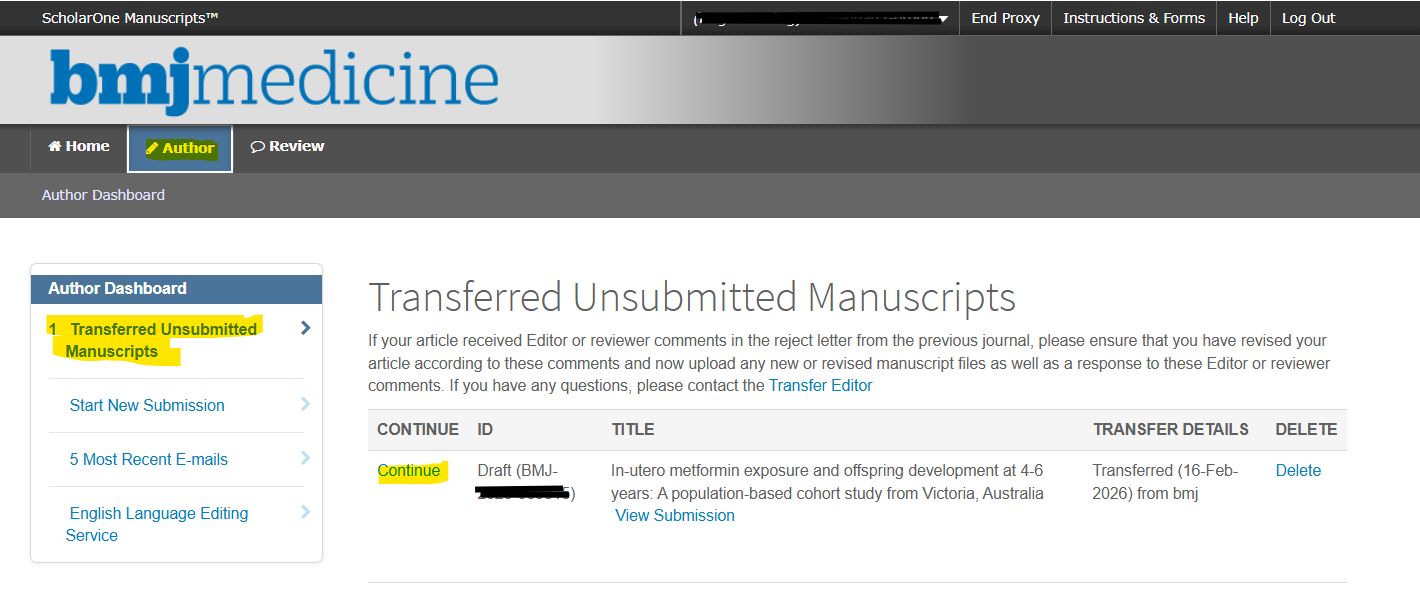
You will see your manuscript in ‘Transferred Unsubmitted Manuscripts’. Please click ‘continue’ next to your manuscript and you will be taken through a few short steps to complete your submission.
Jump to:
- Why transfer your manuscript?
- What should you do if you transfer your manuscript?
- Can I appeal a decision and transfer my manuscript?
- Is there a deadline for when I need to accept my transfer?
- Do I have to transfer my manuscript to submit elsewhere?
- How do I select an alternative journal?
- Do I have to pay to transfer my manuscript?
- What is a post review transfer with editorial consideration?
Why transfer your manuscript?
“Being able to transfer the submission to another well-respected BMJ journal made for an appealing mechanism to resubmit as it allowed us to build on the reviews from our first submission.”
Author, West Roxbury VA Medical Center, Boston, USA
- You’re in control – You decide if and where to transfer.
- Higher chance of acceptance – Many rejections are due to scope, not quality. With over 70 BMJ journals (including BMJ Open), your paper may be a better fit elsewhere.
- Faster decisions – Files and peer reviews transfer automatically, helping editors decide more quickly.
- Build on existing reviews – No need to start the peer review process from scratch.
- Saves time – Reduces re-uploading, new reviewer searches, and duplicated effort.
- Greater reach – Helps place your research in the most appropriate journal to maximise impact.
What should you do if you transfer your manuscript?
- Revise your manuscript in line with the original editor and reviewer comments.
- Update formatting to match the requirements of the new journal.
- Submit your updated files
Note: Your originally submitted files will automatically transfer to the new journal.
Can I appeal a decision and transfer my manuscript?
No, you must choose either to appeal or transfer; simultaneous consideration isn’t allowed.
After an appeal, if your appeal is rejected, you can then consider transferring your manuscript to another journal.
Only one appeal per manuscript is permitted.
Is there a deadline for when I need to accept my transfer?
Yes, your paper will sit in draft in the transfer journal for 90 days. If you do not wish to go ahead with the transfer, no action is required from you and your paper will be removed from draft. If you do still wish to submit to the next journal after the draft has been deleted, you may submit directly to the journal.
Do I have to transfer my manuscript to submit elsewhere?
No. You can submit to a new BMJ journal, but the transfer process is recommended as it saves time by automatically moving your files and peer reviews, reducing work for authors, editors, and reviewers.
How do I select an alternative journal?
- Match by scope, choose a journal based on your manuscript’s subject area, just like your original submission.
- Consider open-access companions, many BMJ journals have a related open-access journal with a wider scope, focusing on scientific quality rather than novelty:
- BMJ Case Reports – clinical case reports
- BMJ Open – all sound science clinical papers
- BMJ Public Health – sound science, population-level research (including non-clinical)
Check each journal’s homepage or contact the Article Transfer Service for further guidance: transfers@bmj.com
.
Do I have to pay to transfer my manuscript?
No, there is no direct fee to transfer, moving your manuscript to another BMJ journal is free.
BMJ Case Reports require a Fellowship to submit; the fee is non-refundable and does not guarantee acceptance. For more information, please visit the journal’s website.
Open access journals (OA) – if accepted, an Article Processing Charge (APC) applies. See here the lists of BMJ’s hybrid journals and open access options. Hybrid journals charge an APC only if you choose open access; otherwise, the green route is free. The APC for each journal can be found on the individual journal’s website. For more information about APCs, please see here.
Waivers, discounts, and agreements – some institutions have OA agreements with BMJ which will either cover the full cost of OA publishing for authors at those institutions or allow authors to receive a discount. Waivers and discounts are also offered in certain circumstances. For details, please visit our open access agreements page and our waivers and discounts page.
Read & Publish agreements – If you are an author from an institution that has a Read and Publish agreement (PAR) for hybrid journals and your manuscript is rejected and transferred from a hybrid to an OA journal, your institution may no longer pay the APC. Please check your agreement for details.
What is a post review transfer with Editorial Consideration?
At BMJ Group, manuscripts that have undergone peer review before rejection are given a priority transfer to another suitable BMJ journal. Our Transfer Editors will identify a suitable BMJ journal and check if its editor is interested in considering a revised version.
While acceptance is not guaranteed—since all BMJ journals are editorially independent—the editor will review a revised submission if the authors address the previous peer review comments.
How it works
- A manuscript is rejected after peer review.
- The Transfer Editor contacts editors of relevant BMJ journals.
- If a journal expresses interest, the Transfer Editor helps facilitate the transfer.
- The manuscript, files, and peer reviews are transferred to the receiving journal.
- A revised version, including point-by-point responses to the reviewer comments and a marked copy is required.
- If authors revise their manuscript based on feedback and reformat it to the new journal’s requirements, acceptance is highly likely.
Benefits of this scheme
- Saves authors time by avoiding resubmission elsewhere and additional rounds of peer review.
- Reduces duplicate effort for editors and reviewers.
- Increased chance of acceptance; BMJ group portfolio average acceptance rate is 21%, post-review transfer with editorial consideration acceptance rate is 52%.
“The Article Transfer Service was a clear, smooth and efficient process.”
Dr Dan Green, Aston University, UK
Last updated: May 2026